

Introduction: Where Real Productivity Begins

You sit down to work with a clear plan—and two hours later, you’ve been busy but not effective, which is exactly where a focus habit tracker becomes essential. Sound familiar?
It’s not a time problem. It’s a focus problem. Small interruptions—emails, messages, quick checks—quietly fracture your attention and steal your best thinking time.
The tricky part? Most of it goes unnoticed.
A focus habit tracker fixes that by making your attention ble. It shows exactly where your time goes, what breaks your concentration, and how to regain control of your day.
In this guide, you’ll learn a simple, practical way to track deep work, reduce distractions, and build a system that fits naturally into a busy professional life.
What Is a Focus Habit Tracker?
A focus habit tracker is a simple system you use to track:
- How long you spend doing deep, focused work
- What distractions interrupt you
- When your energy and focus are strongest
Think of it like a fitness tracker—but for your brain.
But tracking alone isn’t enough—you also need a system behind your work. Here’s how to build a planning system that keeps your priorities clear and consistent.
Instead of steps, you track focus sessions.
Instead of calories, you track distractions.
And just like fitness, what gets tracked… gets improved.
Why Deep Work Matters More Than Ever
Deep work (a concept popularized by productivity expert Cal Newport) is the ability to focus without distraction on cognitively demanding tasks.
In simple words: doing important work without interruptions.
Here’s why it matters:
- You finish tasks faster
- Your work quality improves
- You feel less overwhelmed
- You stop working late just to “catch up”
But here’s the problem: modern life is basically designed to destroy deep work.
Notifications. Emails. Meetings. Slack pings. Random thoughts like, “Wait, did I reply to that message?”
That’s why tracking your focus is so powerful—it exposes what’s actually happening.
How to Track Deep Work (Step-by-Step)
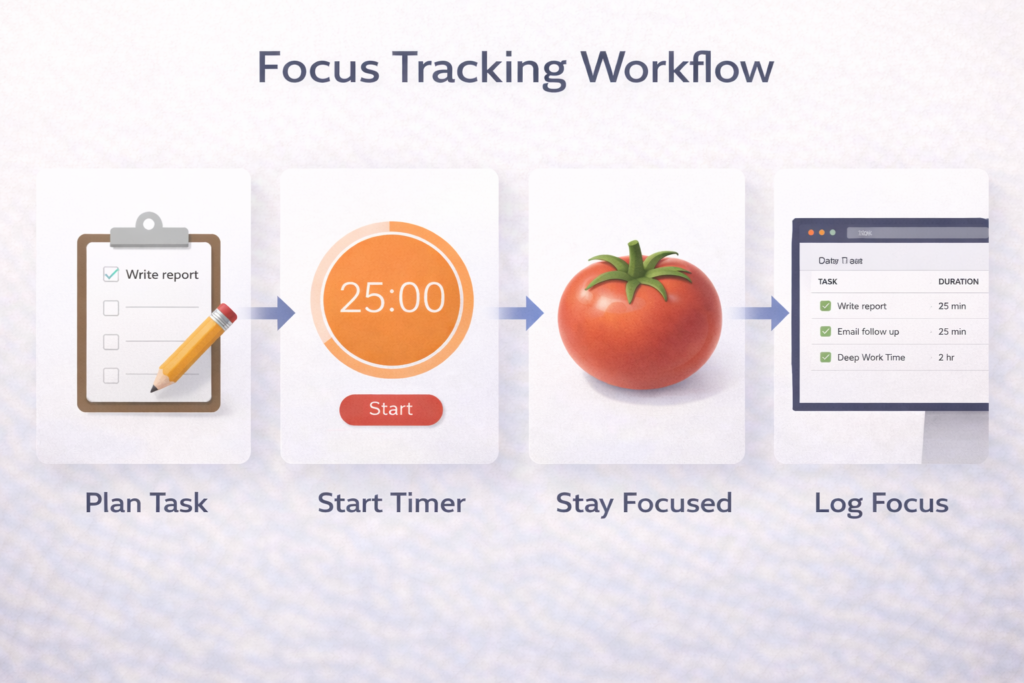
Let’s keep this simple and realistic. You don’t need a complicated system.
Step 1: Define What Counts as Deep Work
Before tracking anything, get clear:
Deep work = focused, uninterrupted work that moves your goals forward.
The challenge is knowing what actually deserves that level of focus—these time prioritization techniques help you decide what matters most.
Examples:
- Writing
- Coding
- Studying
- Strategic thinking
Not deep work:
- Checking emails
- Attending most meetings
- Scrolling or “researching” without purpose
Step 2: Choose a Tracking Method
Pick one that feels easy. If it’s annoying, you won’t stick with it.
Here are your main options:
| Method | Best For | Pros | Cons |
|---|---|---|---|
| Notebook | Simple thinkers | Easy, no tech | Manual effort |
| Spreadsheet | Data lovers | Detailed tracking | Setup time |
| App | Busy professionals | Automated | Can become distracting |
Step 3: Track Your Focus Sessions
Each time you start deep work:
- Note the start time
- Work without interruption
- Stop when you lose focus or finish
- Record the duration
That’s it.
You’re not trying to be perfect—you’re trying to be aware.
Step 4: Track Distractions (This Is the Game-Changer)
This is where most people skip… and where the magic happens.
Every time you get distracted, quickly note:
- What distracted you (phone, email, thought)
- When it happened
Example:
| Time | Distraction |
|---|---|
| 10:15 | Checked phone |
| 10:32 | Opened email |
| 11:05 | Random thought |
You’ll start noticing patterns fast.
Step 5: Review Daily (Takes 2 Minutes)
At the end of your day, ask yourself:
- How many deep work sessions did I complete?
- What distracted me the most?
- When was my focus strongest?
Keep it quick. No overthinking.
A Simple Focus Tracking Template
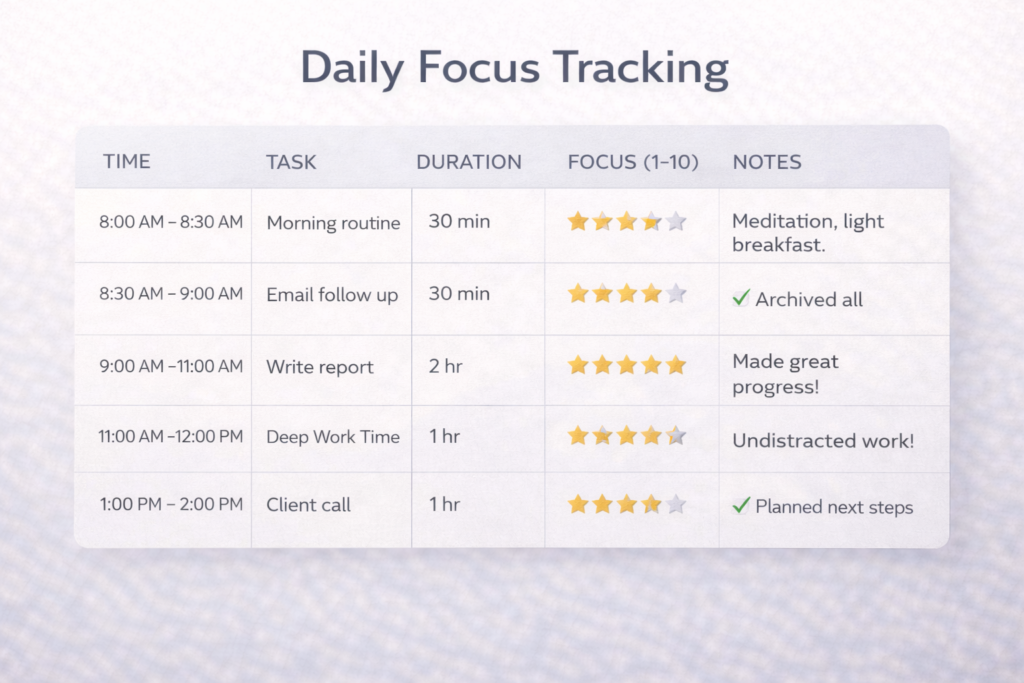
Here’s a clean template you can copy:
| Date | Deep Work Sessions | Total Focus Time | Top Distraction | Focus Rating (1-10) |
|---|---|---|---|---|
| Mon | 3 | 2h 15m | Phone | 7 |
You can use this in a notebook, Notion, or even sticky notes.
Best Focus Habit Tracker Tools (Top Picks)
If you prefer digital tools, here are some great options:
1. Notion (Custom Tracking)
- Flexible and customizable
- Great for combining tasks + tracking
2. Toggl Track
- Easy time tracking
- Clean reports
3. Forest App
- Gamified focus sessions
- Helps reduce phone use
4. RescueTime
- Automatically tracks digital activity
- Shows where your time actually goes
Common Mistakes to Avoid
Let’s save you some frustration.
1. Tracking Too Much
If your system feels like a second job, you’ll quit.
Keep it simple.
2. Expecting Perfect Focus
You’re human. Distractions happen.
The goal is progress—not perfection.
3. Ignoring Patterns
Tracking without reviewing = wasted effort.
Look for trends and adjust.
4. Using Tracking as Procrastination
Don’t spend 2 hours building the “perfect system.”
Start messy. Improve later.
How to Reduce Distractions (Based on Your Data)
Once you track for a few days, you’ll see patterns.
Now fix them:
If Your Phone Is the Problem:
- Put it in another room
- Use focus mode
If Emails Interrupt You:
- Check email at set times only
If Your Mind Wanders:
- Keep a “distraction list” to park thoughts
A Real-Life Example (Quick Story)
I once thought I worked “8 hours a day.” Tracking proved otherwise.
Actual deep work? Around 2.5 hours.
The rest?
Tiny distractions. Context switching. “Quick checks.”
After tracking for a week, I:
- Reduced phone use
- Batched emails
- Scheduled deep work in the morning
Result? Same workload… less stress… and I finished earlier.
Tracking didn’t magically give me more time—it gave me control.
FAQs: Focus Habit Tracking
1. How long should a deep work session be?
Start with 25–50 minutes. Increase as your focus improves.
2. How many deep work sessions per day is ideal?
For most professionals: 2–4 sessions is realistic and effective.
3. Can I track focus without apps?
Absolutely. A notebook works perfectly.
4. What if I keep getting distracted?
That’s the point of tracking—you’re identifying the problem so you can fix it.
5. How long before I see results?
Most people notice changes within 3–7 days.
Conclusion: Focus Is a Skill—Train It
Here’s the truth: you don’t need more time.
You need better focus.
A focus habit tracker is one of the simplest tools to make that happen.
Start small:
- Track one session today
- Notice one distraction
- Improve one thing tomorrow
That’s it.
Consistency beats complexity.
Call to Action
Try this today:
👉 Track just one deep work session and write down every distraction.
You’ll be surprised what you discover.
And once you see it… you can finally take control of your time.